
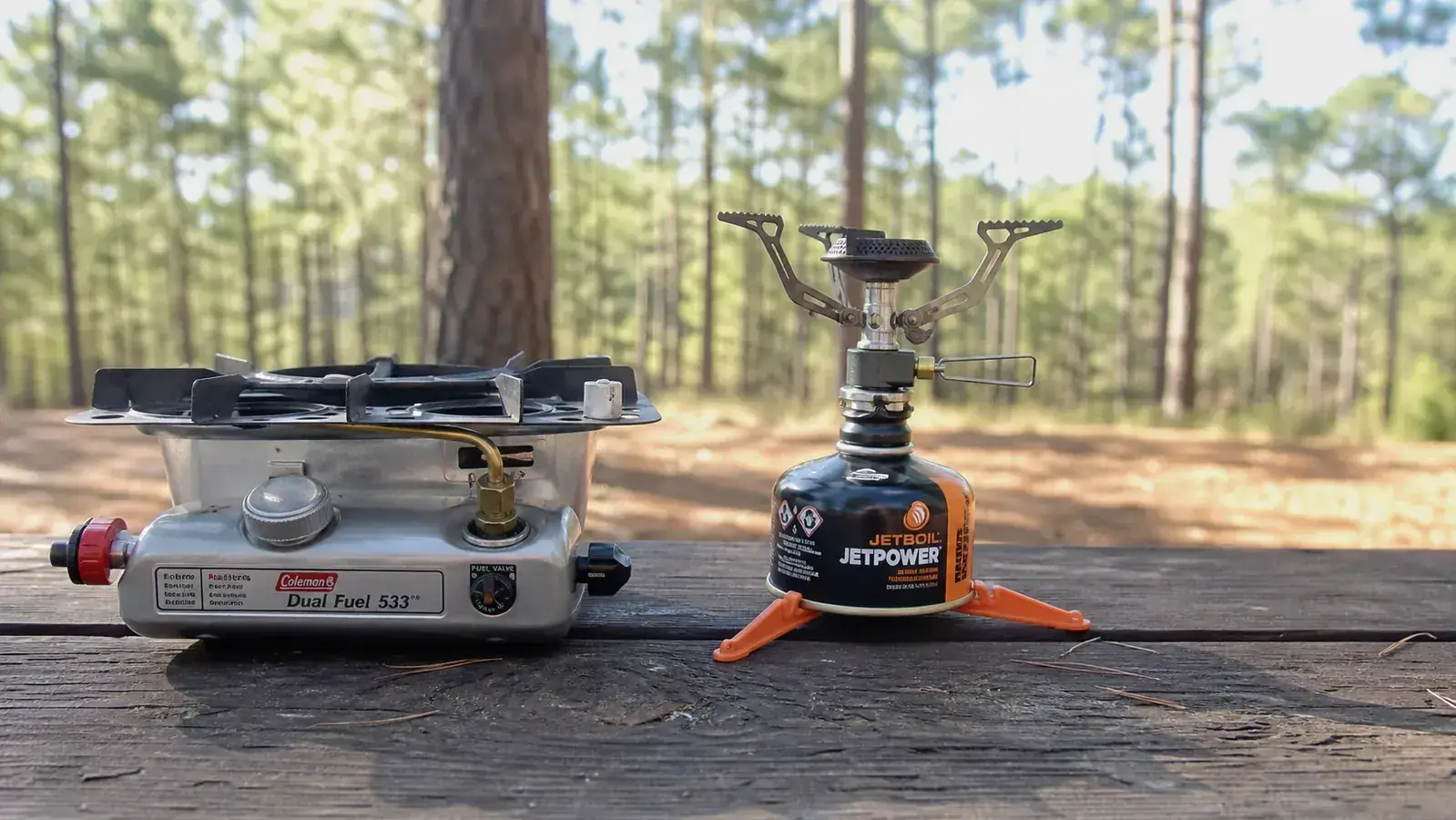
Short answer: if you want one stove that works regardless of what fuel is on the shelf at the gas station 40 miles from your campsite, the Gas One GS-3400P wins this comparison without much debate. The Coleman BottleTop is fine for what it is, a no-fuss propane burner that threads onto a 1-lb canister and gets out of the way, but it ties you to propane availability and that single constraint has burned me more than once on remote trips.
I cooked the same Saturday-morning breakfast on both stoves at the same campsite in the Ocala National Forest last spring. Scrambled eggs, canned black beans, and a pot of water for pour-over coffee. Same wind. Same morning temperature, about 52 degrees. I took notes on lighting time, heat distribution, flame control, and pack footprint. Here is what I found.
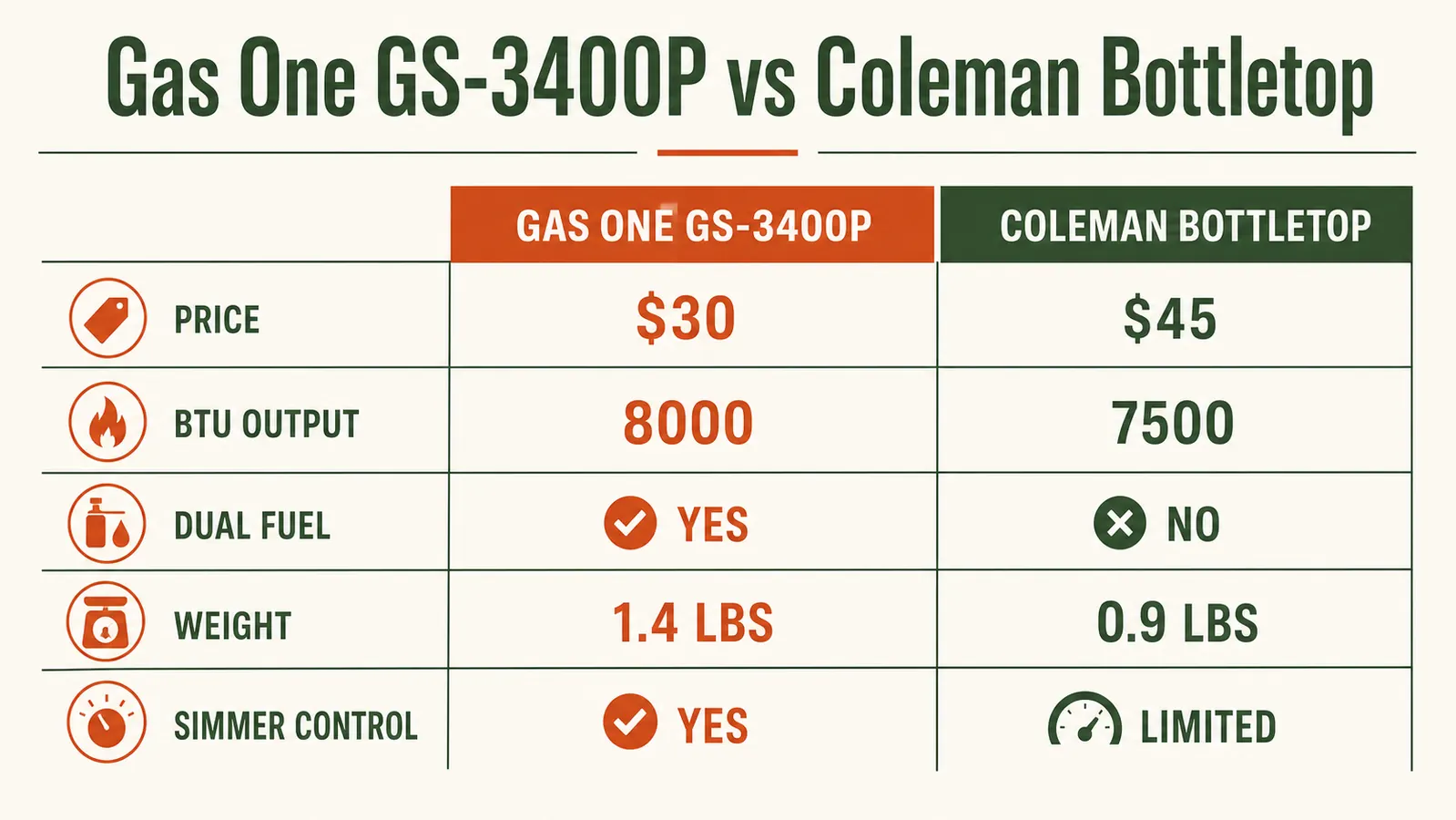
| Gas One GS-3400P | Coleman BottleTop Propane Stove | |
|---|---|---|
| Fuel Type | Propane OR butane (dual fuel) | Propane only (1-lb canister) |
| BTU Output | 9,000 BTU | 7,500 BTU |
| Stove Weight | 1.25 lbs (stove only) | 0.9 lbs (stove only) |
| Packed Size | 6 x 6 x 3.5 in (in carry case) | 4 x 4 x 6 in (on canister, no case) |
| Wind Resistance | Recessed burner head, partial windscreen | Open burner, minimal shielding |
| Carry Case Included | Yes, rigid plastic case included | No case, ships loose |
| Ignition | Piezo push-button igniter | Piezo push-button igniter |
| Simmer Control | Smooth low-to-high range | Workable but coarser adjustment |
| Approx. Street Price | Affordable (see current price) | Budget-friendly (no affiliate link) |
Where the Gas One GS-3400P Wins
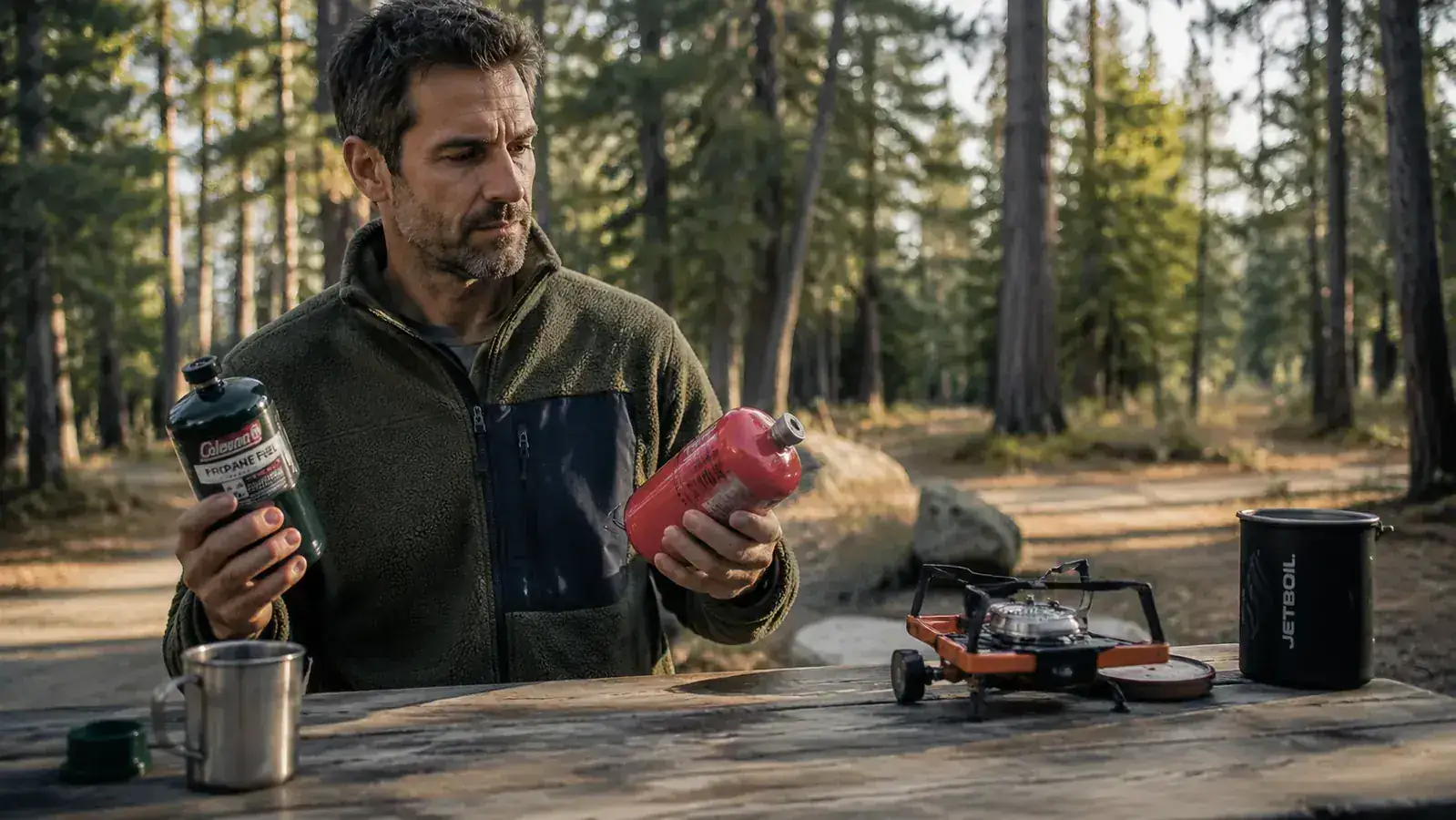
Fuel flexibility is the headline feature and it is a real one. The GS-3400P accepts both propane canisters and butane canisters, and it ships with a butane adaptor. When the camp store is out of the green 1-lb propane cans, or when I am in a country where butane is the only portable fuel sold, I am still cooking. That flexibility alone has justified the Gas One's spot in my kit on probably a dozen trips since 2022.
The BTU advantage is real but modest. Nine thousand BTU versus 7,500 means the Gas One brought two cups of water to boil about 90 seconds faster in my side-by-side test. That gap widens in cold weather because butane loses pressure when temperatures drop toward freezing, while propane performs more reliably in the cold. If you camp from October through April, that matters. The Gas One also has a noticeably more refined simmer control, which I appreciated for the eggs. The Coleman runs hotter than you need at the low end and dialing it back precisely takes patience.
The included rigid carry case is a practical win that does not show up in spec sheets. My Gas One has lived in the bottom of a duffel bag, been stacked under cast iron, and banged around in the bed of a truck. The case has kept the burner head and regulator adapter scratch-free and protected. The Coleman BottleTop ships loose and relies on the canister itself as the base, so it either goes in a bag unprotected or you find your own solution.
If your campsite fuel plan is 'whatever is on the shelf,' the Gas One is the stove that never strands you.
The GS-3400P runs propane or butane, comes with a carry case, and fits in the corner of any camp bag. Over 14,000 Amazon reviews back it up.
Amazon Check Today's Price on Amazon →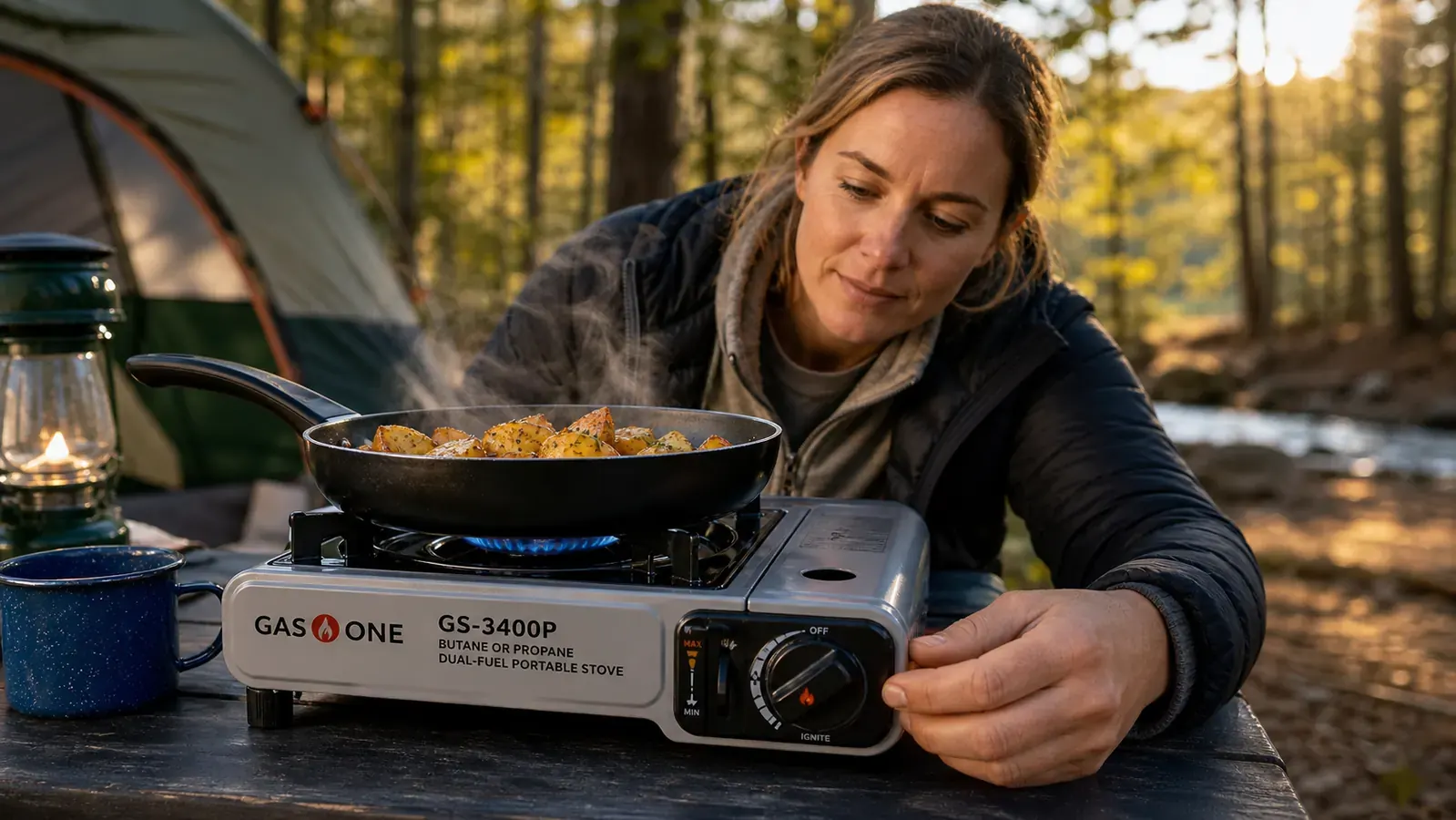
Where the Coleman BottleTop Wins
The Coleman BottleTop is lighter, simpler, and cheaper. If your camping style is strictly car-camping at established campgrounds where propane canisters are always for sale at the ranger station kiosk, the fuel flexibility argument mostly disappears and the Coleman's lower price and stripped-down design make a lot of sense. It is also a well-known name, which matters to some campers who want a brand with 100-plus years of outdoor credibility behind it.
The size argument also slightly favors the Coleman when everything is attached. The stove and 1-lb canister together make a reasonably compact unit for throwing in a daypack for a quick solo trip where weight and bulk are the primary concerns. The Gas One with its carry case is a bit bulkier, though the case makes it more packable in a soft bag since you can squeeze it into gaps without worrying about the burner getting dinged. It is a tradeoff, not a clear win for either side.
The Coleman is a perfectly fine stove. The Gas One is a stove I trust on any trip, regardless of where it lands on the map.
Real-World Performance Notes From the Campsite
Both stoves lit on the first push of the piezo igniter, which is what you want to see on a cold morning when your hands are not fully awake yet. The Gas One's flame was more centered and the heat spread more evenly under a 9-inch skillet. With the Coleman I got a slight hot spot in the middle of the skillet and had to move the pan a few times during the egg cook. Not a dealbreaker, but noticeable.
Wind performance surprised me a little. The Coleman's open burner head is more vulnerable to even a light breeze. I was cooking in maybe 6-mph intermittent gusts and the Coleman's flame dipped and wobbled more than the Gas One's. The GS-3400P has a recessed burner design that provides partial shielding and I could see the difference in flame stability without adding a separate windscreen. In a dead-calm spot this does not matter at all, but on exposed sites it is a real advantage for the Gas One.
Cleanup was similar for both. Wipe the grate, check the burner for debris, store. The Gas One's carry case makes post-trip storage cleaner since I do not have a loose stove head rattling around a bag. One thing I check after every trip is the regulator connection on the Gas One's dual-fuel adapter, making sure it threads cleanly. I have never had a seal issue but it is a habit I built after two seasons with dual-fuel stoves of any brand.
Who Should Buy Which
Buy the Gas One GS-3400P if you camp more than a few times a year, if you ever travel to remote areas or international destinations, or if you want one stove that stays in your bag regardless of the trip. The dual-fuel flexibility, better BTU output, carry case, and wind-resistant burner combine into a package that is worth the small price premium over the Coleman. For the full breakdown of how the GS-3400P performs across two full camping seasons, read my long-term review.
Buy the Coleman BottleTop if you camp two or three times per summer at well-stocked state park campgrounds, you already have a supply of 1-lb propane canisters, and you want the absolute simplest possible cooking setup with no adapters to keep track of. It will serve you fine in those conditions and the cost savings are real. Just know you are trading flexibility for simplicity.
If you are newer to camp cooking and want to learn the full system for getting fast, hot meals out of a portable stove, the how-to guide on cooking camp meals fast covers the method I use on every trip with the Gas One.
The stove that works whether you grab propane or butane at the last gas station.
The Gas One GS-3400P has 4.6 stars across nearly 15,000 Amazon reviews, fits in a carry case, and costs less than a tank of gas. It is the stove Marcus recommends to every camper stepping up from campfire-only cooking.
Amazon Check Today's Price on Amazon →